Imagine your team retrains a model every month. The current dataset has to be ready when the next run starts. The last working model has to be recoverable if a release fails. And the original dataset may need to be kept so you can reproduce earlier results. Those are three different jobs, and they don't all need the same storage.
Three Jobs for AI Data Centre Storage
01 · Active data
Keep the datasets and model files your workloads use regularly on online storage sized for the access speed and throughput they need. Measure how quickly a training job can load its data and restart.
02 · Backup and recovery
Protect copies of priority datasets, model checkpoints and configurations. Decide how much recent work you can afford to lose and how soon the workload must be running again.
03 · Long-term archive
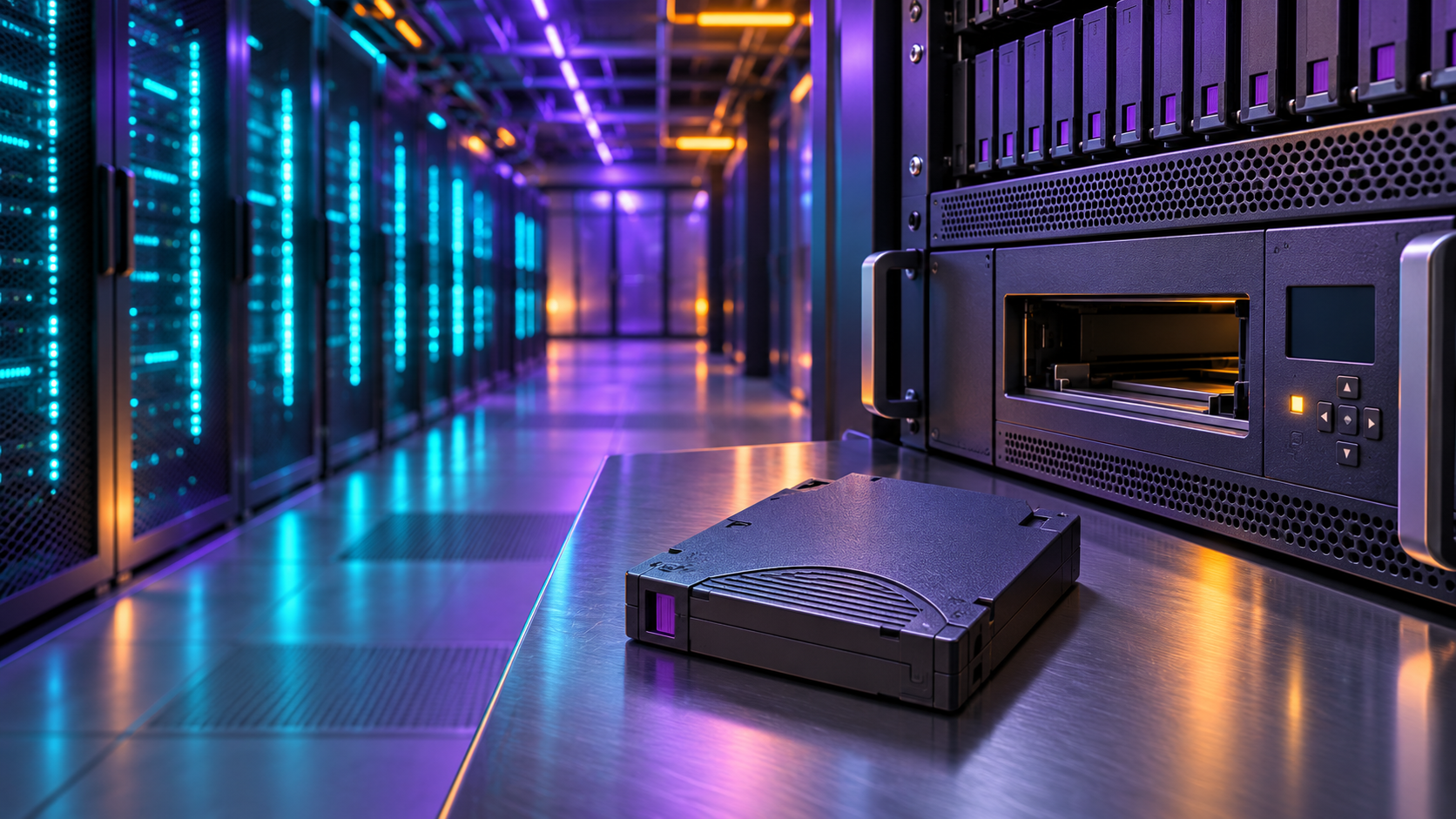
Keep selected datasets and model versions for as long as your retention policy allows. LTO tape can suit material you rarely retrieve and can restore to online storage before using it.
Where LTO Tape Fits
Tape is a candidate for long-term retention and offline backup. It isn't the working storage for a live training or inference job. If a workload has a short recovery deadline, keep a faster recovery copy and test how long the full restore takes.
Buying LTO-9 cartridges? IBM lists 18 TB native and 45 TB compressed per cartridge at an assumed 2.5:1 compression ratio. Use native capacity for planning unless you've measured compression on your own data. Already compressed files may yield little extra space. Before ordering, check that your exact drive supports the cartridge and the read or write operation you need.
When Is a Tape Copy Actually Offline?
A cartridge exported from the library and stored securely can give you an offline copy. Simply writing to tape in a network-managed library doesn't establish that isolation. CISA recommends offline, encrypted backups of critical data and regularly testing that those backups can be restored.
Test the whole process: find the cartridge, open the backup catalogue, retrieve the encryption key if needed, and restore a sample dataset or checkpoint. Record how long it took and check that the restored files can actually be used.
Example: One Dataset, Three Decisions
A team retrains a model monthly and needs to retain the original dataset.
- Keep online: The current training dataset and checkpoints needed to resume the current run.
- Back up: The last working model, its configuration and the data version it depends on. Test whether the team can restore them together.
- Archive: The approved original dataset and selected model versions. Keep a catalogue so the team can identify and retrieve the right copy later.
Before archiving personal or licensed data, confirm your permission to retain it and the applicable deletion rules.
Planning AI Storage or LTO Backup in Pakistan?
Tell Four Bridges what you need to protect, how much data you hold, how quickly you need it back, and what drives or libraries you already use. Start with our Tape Drives & Storage solutions or compare cartridge generations in our LTO tape media guide.